|
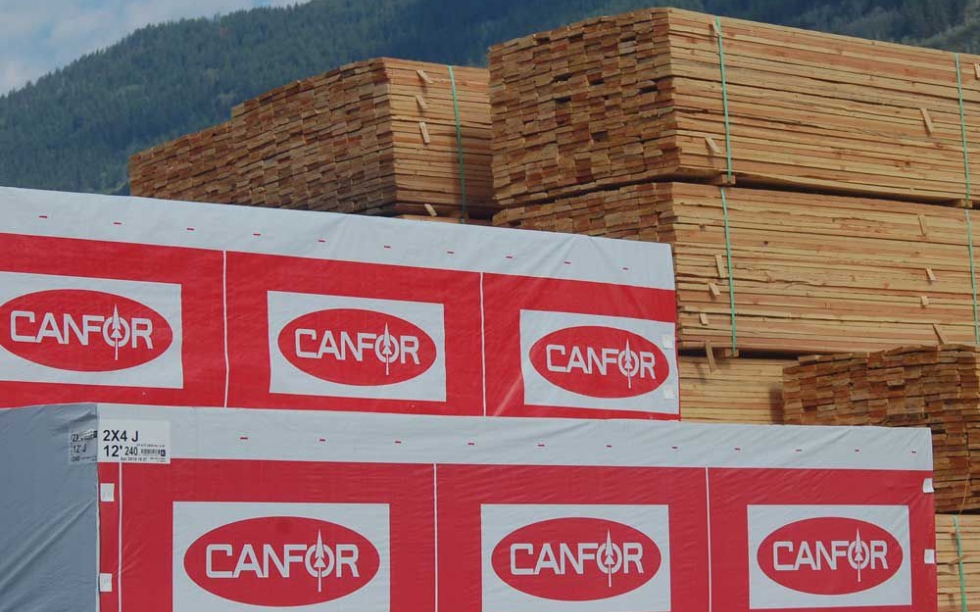
Canfor’s Sawmills and Taylor Pulp Mill in BC Hit by Supply Chain Crisis
March 30, 2022 - Canfor Corporation today announced that it will implement reduced operating schedules at its Western Canadian sawmills (in British Columbia, Canada) effective April 4, 2022 due to the cumulative effects of the unprecedented global supply chain crisis that has been ongoing for several months.
The reduced operating schedules will remain in effect for a minimum of four weeks and the company will continue to assess and make adjustments to operating schedules as supply chain conditions evolve.
"We are experiencing extreme supply chain challenges that are significantly impacting our operations and it has become imperative to reduce operating schedules to address our unsustainable inventory levels. We regret the impact that the reduced operating schedules will have on our employees, contractors and communities and we will make efforts to mitigate the negative effects," said Don Kayne, President and CEO, Canfor. "We will continue to leverage our global operating platform to minimize disruptions in supply to our customers."
It is anticipated that the reduced operating schedules will impact production capacity by a minimum of 100 million board feet.
Taylor Pulp Mill
A day earlier, Canfor Pulp announced a minimum six-week extension of the curtailment of BCTMP production at Taylor Pulp due to the ongoing transportation shortages that have resulted in continued high finished product inventories at the pulp mill.
In mid-February, Canfor Pulp said that it was forced to curtail the production of BCTMP at the Taylor mill for six weeks due to lack of transportation to ship product and inventories at the mill reaching capacity. The first six-week curtailment reduced the mill's production by about 25,000 tonnes.
"Unfortunately, the ongoing rail transportation situation has not improved, and we have no choice but to extend the current production curtailment," said Kevin Anderson, VP Operations, Canfor Pulp. "We are very disappointed in the ongoing impact this is having on our employees, their families and the community."
The curtailment extension will further reduce the production of BCTMP by at least 25,000 tonnes.
SOURCE: Canfor |
|
|

UPM Optimistic About Reaching Agreement Soon with Paperworkers Union in Finland
March 22, 2022 - UPM today said that Conciliator Leo Suomaa has submitted a proposal for a settlement in the collective labour agreement negotiations between UPM Pulp and the Paperworkers' Union. The conciliator has asked the parties to state their position on the proposal by 14 April 2022 at 10:00 EET.
In the meanwhile, the conciliator will continue the conciliation with the Union and with UPM's other businesses. Paperworkers' Union has now also agreed that all business can run the negotiations parallel instead of having them one by one.
"I am pleased that the negotiations have reached a point where the conciliator has seen it possible to submit a proposal for a settlement," said Juha Kääriäinen, Vice President, Finland Pulp Operations at UPM Pulp, the chief negotiator for UPM Pulp. "I am hopeful that the agreement will be reached, and I hope we get to start the mills as soon as possible."
The Paperworkers' Union's strike at UPM Pulp, UPM Biofuels, UPM Communication Papers, UPM Specialty Papers and UPM Raflatac units in Finland began 1 January 2022.
SOURCE: UPM |
|
Stora Enso Announces Plans to Divest Four Paper Mills in Europe
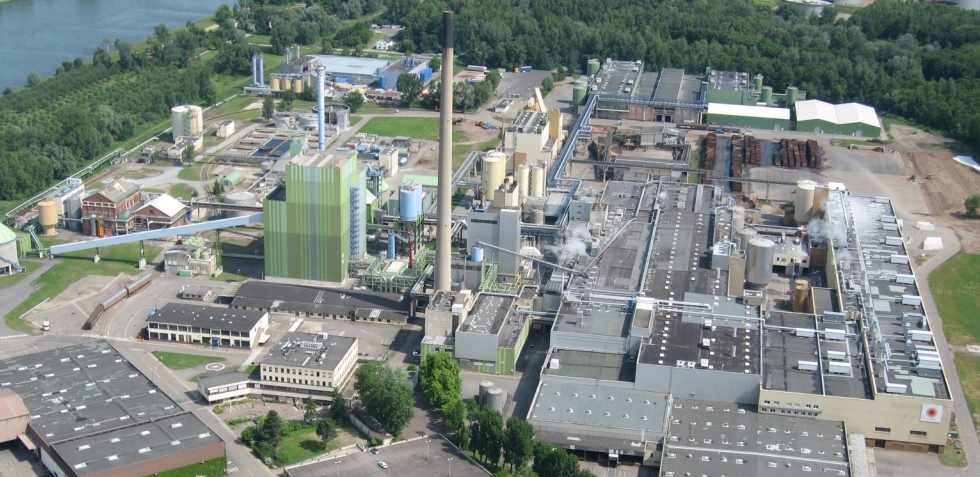
March 29, 2022 - Stora Enso has initiated a sales process for a possible divestment of four paper production sites. In line with Stora Enso’s strategy, paper is not a strategic growth area for the Group. The divestment intent is aligned with the Group’s strategy to focus on long-term growth potential for its renewable products in packaging, building solutions and biomaterials innovations.
Stora Enso’s paper production sites intended for divestment are: Anjala in Finland, Hylte and Nymölla in Sweden, and Maxau in Germany. The assets are high-quality sites for paper and pulp production with strong infrastructure, and skilled and experienced staff.
“Through divesting a majority of our paper assets, we are able to increase the focus on our defined strategic growth areas of renewable packaging, building solutions and biomaterials innovations,” said President and CEO Annica Bresky. “When assessing potential divestment options, we look for new ownership that will provide a sustainable long-term future for the sites and the people that work there.”
The four Stora Enso sites are subject to divestment in one or a series of transactions.
Stora Enso has not committed to a deadline for the conclusion of the divestment process.
The initiated sales process has no immediate effect on Stora Enso’s paper operations which continue to serve their respective customers.
Stora Enso’s Langerbrugge site in Belgium will be retained within the Group.
Stora Enso currently has five paper production sites that are supported by divisional sales, management, and administrative functions. In total, the Paper division currently employs approximately 2,200 employees. In 2021, the Paper division’s net sales amounted to EUR 1,703 million.
About the Mills
Anjala Mill in southern Finland produces printing paper from mechanical pulp — both coated and uncoated book paper, magazine paper and improved newsprint grades. Annual capacity: 435,000 tonnes of paper.
Hylte Mill in southwest Sweden is one of the largest newsprint mills in the world, and produces high-quality newsprint, biocomposites and Formed Fibre products. Annual capacity: 240,000 tonnes of Newsprint based on TMP (thermo-mechanical pulp), 15,000 tonnes of Circular Solutons and 50 Million units of Formed Fiber products.
Nymölla Mill in southern Sweden produces pulp and wood free uncoated paper, including the product Multicopy. Annual capacity: 475,000 tonnes of paper and 340,000 tonnes of pulp.
Maxau Mill in southwest Germany produces supercalendered paper primarily from recovered paper. Annual capacity: 530,000 tonnes of paper and 270,000 tonnes of pulp.
SOURCE: Stora Enso |
|

Meadow Lake Tribal Council Joins Paper Excellence’s Call for CN to Provide More Rail Cars
March 7, 2022 (Press Release) - Meadow Lake Tribal Council (MLTC) joined Paper Excellence today in calling on CN to provide more rail cars for Meadow Lake Mechanical Pulp Inc.
The pulp mill is dependent on CN, which has failed to adequately transport Meadow Lake mill’s product to ports for months. After exhausting all local storage facilities, Paper Excellence leadership announced a further production slowdown due to the lack of rail service on February 11th. The mill has not operated at full capacity since December.
Currently, CN continues to provide less than 40% of requested rail cars and now the mill has had to resort to participating in a CN auction process that drives up prices for the few cars that are available.
Meadow Lake Mechanical Pulp employs 190 people and contributes over $1 million daily into Canada’s economy. The mill is also an equal partner in Mistik Management Ltd. (Mistik) that holds the provincial Forest Management Agreement for the area. Mistik is an equal partnership between Meadow Lake Mechanical Pulp and NorSask Forest Products, which is owned by the Meadow Lake Tribal Council. For more information about Mistik Management Ltd, read this Practices and Perspectives story from our current sustainability report.
“MLTC has been a long-term business partner of the Meadow Lake Mechanical Pulp mill since 1989. Our business partnership with the Meadow Lake pulp mill provides sustained employment and financial benefits, resulting in increased opportunity, well-being, and overall prosperity for our First Nation membership. We encourage CN to immediately provide better rail service for Meadow Lake Mechanical Pulp Mill. Any negative business impact to our long-term partner can translate into negative impacts on employment opportunities affecting our communities and overall business sustainability,” said MLTC Tribal Chief Richard Ben.
“700 local jobs are dependent on the local supply chain for this mill, and many of those jobs are held by members of local Indigenous communities,” said Graham Kissack, Vice President Environment, Health & Safety, and Corporate Communications. “Our partnerships with Indigenous businesses in and around the Meadow Lake community has been a success story we are proud of. However, the profitability of the mill and its forestry providers hinges on running at full capacity and getting our product to market. This can only happen if CN provides proper rail service.”
About Meadow Lake Mechanical Pulp Inc.
The Meadow Lake pulp mill has the capacity to produce 410,000 tonnes of BCTMP (Bleached Chemi Thermal Mechanical Pulp) per year, which is exported to customers primarily in Asia.
SOURCE: Paper Excellence |
|
Russia's Invasion of Ukraine Will Likely Halt Planned Investments in the Russian Forest Industry
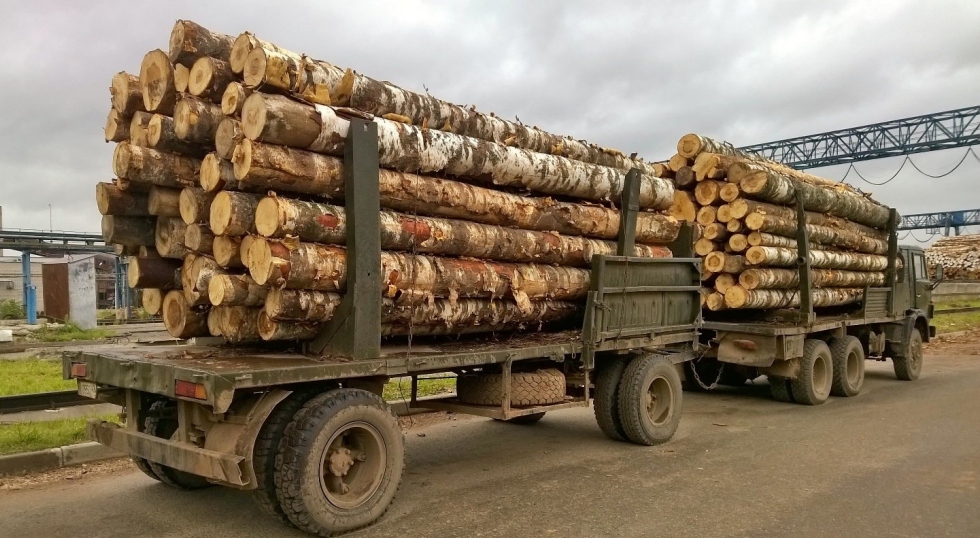
Feb. 28, 2022 (Wood Resources International - Market Insights) - Russia's invasion of Ukraine is likely to impact global trade in the coming months. Increased sanctions against trading with Russia and difficulty with financial transactions will probably interrupt and re-direct shipments of forest products throughout the world. As a result, trade with Russia will likely decline, impacting long-established international trade flows of forest products.
Countries like China and India, who have reluctantly supported Russia in the conflict, may also be affected by limited trade sanctions. This development would mainly affect China, which relies on the importation of forest products, including logs, wood chips, lumber, pulp, and paper from North America, Europe, Oceania, and Latin America for domestic use. These world regions are considering expanded sanctions for Russia and countries that directly or indirectly support Russia's attack on Ukraine.
Governments in North America and Europe are also seriously considering locking Russia out of the international SWIFT money transaction system. If this occurs, Russian companies will find it challenging to trade with the world.
Russia exported forest products were valued at over 12 billion dollars in 2021, and imports of paper products (mainly) are valued at about 2 billion dollars, according to Wood Resource Quarterly. Much of this trade is in jeopardy.
Russia is the largest lumber exporter globally and ranks as the seventh biggest exporter of forest products worldwide. Forest products exports from Russia have increased rapidly in the past five years, led by softwood lumber and paper products (see table).
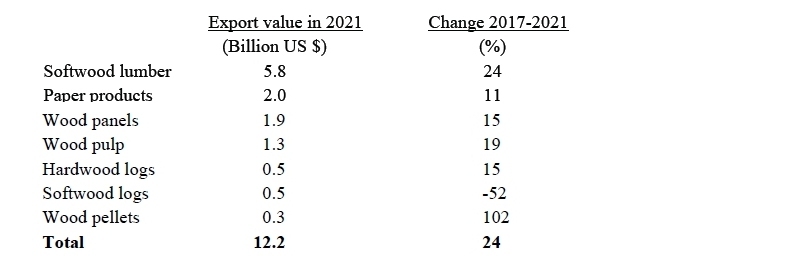
Note. An estimated 40% of exports were destined for China, while the remainder was predominantly shipped to European markets.
Russia has vastly under-utilized forest resources and has the potential to increase timber harvests to supply its domestic industry. To meet increased global demand for forest products, the Russian government recently initiated programs to encourage investments in the sector to both expand/modernize existing manufacturing plants and build greenfield facilities.
However, it is likely that many investments projects in the forest products manufacturing sector in Russia will grind to a halt as the growing list of sanctions and financial transaction restrictions take effect.
Wood Resources International's "Market Insights" cover the most recent developments in regard to global wood supply, forest industry production, forest products trade, and pricing of sawlogs, pulpwood, wood chips, lumber and biomass. WRI also publishes Wood Resource Quarterly. To learn more, visit: www.woodprices.com.
SOURCE: Wood Resources International LLC |
|
|